Early Italian Renaissance:
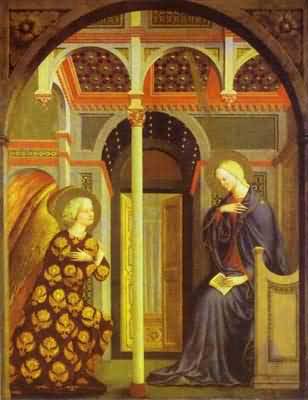
The Annunciation
Masolino da Panicale
This image is a great example of Early Italian Renaissance art. In the image you can see how they still have remnants of the late gothic period, such as the tendency to put in golden backgrounds. You have the beginnings of humanism in Mary's reaction, the hand against her chest expressing disbelief and encouraging the reader to empathize and relate. The architecture still leans toward the gothic arches and the background remains flat, unlike the later High Renaissance piece we will look at.
High Italian Renaissance:
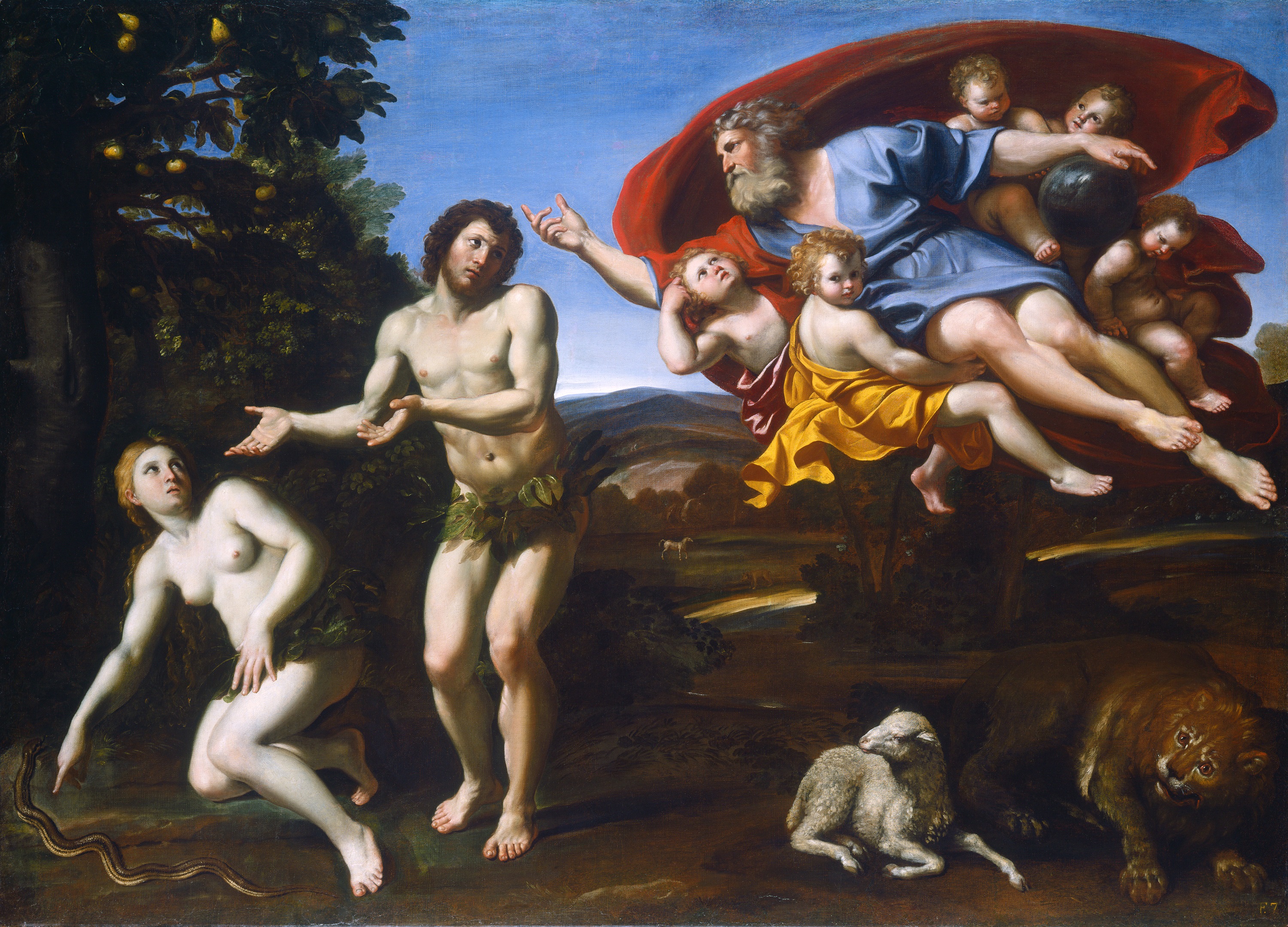
The Rebuke of Adam and Eve
Domenichino
This piece references another famous High Renaissance painting, the Creation of Adam from Michelangelo's sistine chapel. It encompasses the High Renaissance well in that you can see the exaggerated use of lighting and contrast, otherwise known as "chiaroscuro." It also has a distinct appeal to the humanistic elements of the high Renaissance with the emotional response Adam and Eve have to the rebuke by God. It also has the sense of depth and naturalism that are distinctive of the high Renaissance.
15th Century Northern Renaissance:

Portrait of a Merchant
Jan Gossaert
This painting is a fabulous example of the 15th Century Northern Renaissance and the detail artists of that time period paid to sight, detail, and realism. Born from the reading of the book The Vision of God by Nicholas of Cusa, Northern Renaissance painters looked out and saw how much care God put into making the world and believed that as fellow creators they should do the same. The fabric in this painting appears almost as if you could reach out and stroke it, the paper and writing utensils are incredibly realistic, and no area of the painting is given less than extreme detailing from the artist.
16th Century Northern Renaissance:
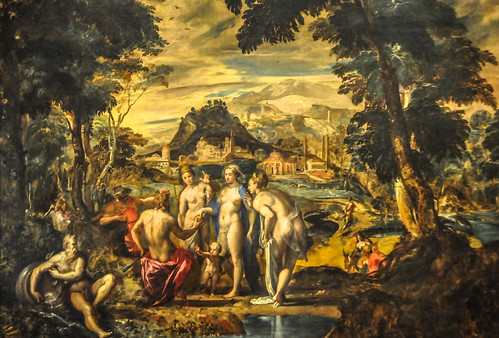
The Judgement of Paris
Giovanni
Between the 15th and 16th centuries of the Northern Renaissance artist's continued to keep much of their focus on the detailing of their work. They also began to have a fascination with the human body, with portraying the body's of women in particular as something you could reach out and touch. This painting is a perfect example of such a practice.
Italian Baroque:

Diana and Endymion
Luca Giordano
Italian Baroque paintings often contained a certain theatrical quality, with emphasis on light and diagonals, as well as pulling the viewer in and making them a part of the scene. This painting is a wonderful example of the use of diagonals in composition, first with Endymion's reclining form, and again with Diana as she swoops down from the sky. This painting has caught us in the middle of the action, another characteristic common in Baroque paintings. The figures in the image all seem to be contained in a box, a sort of allusion to Greek theatre, as if they are composing their painting as if on a stage.
Dutch Baroque:

Descent from the Cross
Rembrandt Workshop
Holland, like Italy, had a strong focus on the theatrical during the Baroque period. Here is another strong example of a diagonal in the way Christ's body sags from the cross into the waiting arms of his followers. Again our characters are situated in the exact center of the portrait, as if the frame were, in fact, a stage. The depth of emotion of the people's faces is another focus, a way to pull the viewer into the action and make them feel as if they were a part of the scene.
Spanish Baroque:

Return of the Prodigal Son
Bartolome Esteban Murillo
Unlike Holland and especially unlike Italy there is not as much movement in Spanish Baroque paintings, however there is still just as much drama. Spanish artist's used the more subtle facets of human emotions in the composition, such as the father's stooped back, as if he can feel the weight of his son's absence and consequent return as a physical thing, and the depth of gratitude on the son's face speaks volumes about the importance of the scene. Spanish paintings are known for being grittier, more realistic in their textures and settings, which is evidence in the clothing of the figures in this painting, which looks as thought you could reach out and feel it against your skin.
French Baroque:

Landscape with Apollo and Mercury
Claud Lorrain
To understand the French Baroque you must first understand the importance of Louis XIV, the absolute monarch and self-proclaimed "sun king." Louis wanted order and opulance in every aspect of French art and the order especially becomes apparent in the paintings of the French Baroque. There is little frivolity in the paintings, such as this orderly landscape shown above. This is an example of a history painting, first and foremost among the hierarchy as set by the Evole des Beaux Arts, established by Louis XIV in 1648.A history painting is some kind of historical narrative, often classical, such as we see here, or biblical. Following the History Paintings in the hierarchy are Portraits, Genre Scenes, Landscapes, and Still Life Observation is not key, but instead imagination rules.
Rococo:

Misse and Luttine
Jean-Baptiste Oudry
Unlike, and in fact directly in response to, the French Baroque, the Rococo is less about order and more about fun. The paintings tend to lean towards the jovial and light, with characters and scenes depicting a sense of freedom and joy, such as the scene above where you see two dogs frolicking in play. It was a way for the French artists to break free form the oppressive rule of Louis XIVand further expand their artistic development.
Thank you for reading!
